
Information
Discover how the Craft & Technology department nurtures creativity and skills through Art, Design & Technology, Nutrition & Food Science, and Music.
Information
The Craft & Technology department comprises four units:
Art
Design and Technology
Food and Consumer Education / Food and Nutrition
Music
Art
The syllabus aims to develop students as active artists and informed audience with:
• Curious minds that are open to exploring and experimenting in art.
• Critical and inventive thinking in creative expression.
• Personal voice and capacity to collaborate with others in art.
• An awareness, interest, and respect for art from diverse social and cultural perspectives
Pedagogies & Modes of Instruction
Art is learned through hands-on sessions which engage all the five senses. The use of visuals and multi-media enables students to have a deeper understanding and appreciation of different art forms. Students also leverage technology to learn collaboratively.
Key Programmes & Activities
Pop- Art
Tessellation
Cubism abstract art
25th Anniversary Mural using recycled bottle caps ( VIA)
Self Portrait Mixed Media
Printmaking
Upper Secondary Art Learning Journey to Museums and Art Exhibitions
Design & Technology
The aim of Design & Technology (D&T) is to enable pupils to harness their innate curiosity and ability to create through design-and-make activities. It enables students to develop their dispositions for enterprise, creativity and innovation by identifying and responding to design needs through the process of research and observation, idea conceptualisation and development, graphic communication and working with appropriate tools and materials.
D&T is a compulsory subject for lower secondary students, while at upper secondary level, it is offered as an elective for interested students. Lower secondary students do not sit for a written examination, but they submit their coursework for assessment instead. Upper secondary students have to submit their coursework and sit for written examinations as part of their assessment.
Pedagogies & Modes of Teaching
Coursework is a core component of the curriculum for this subject, transcending all levels from Secondary 1 to 5. Through execution of the coursework and practical activities, students articulate their design problem solving capabilities.
During Secondary 1 and 2, the emphasis is on understanding and appreciating the whole design cycle. During Secondary 3, the focus is on enhancing the research and decision making aspects, as well as to improve students’ ability in doodling and sketching for ideas exploration.
Key Programmes & Activities
Tealight cum Handphone Holder using Aluminium and Wood
Mini Torchlight
Designing for Elderly with Walking Stick
Coursework Projects at Sec 3
Cardboard Modelling
Digital sketching/ideation using Sketchbook app
Nutrition and Food Science (NFS) Curriculum
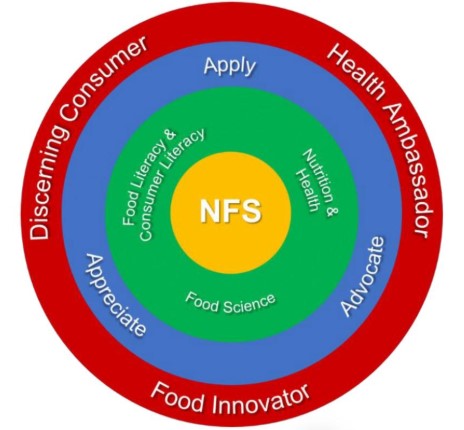
The NFS Curriculum Framework provides a holistic approach to developing students as Health Ambassadors, Discerning Consumers, and Food Innovators. Grounded in the key strands of nutrition and health, consumer literacy, and food science, it connects classroom learning to real-life applications through hands-on, reflective, and student-centred experiences.
At Lower Secondary, the Food & Consumer Education (FCE) programme empowers students to make informed food and lifestyle choices. They explore nutrition, food safety, resource management, and sustainable living while applying basic culinary science to prepare healthy meals. Through practical learning, students build essential life skills such as critical thinking, creativity, and communication, and develop positive attitudes like confidence, curiosity, empathy, and responsibility.
At Upper Secondary, Nutrition and Food Science (NFS) deepens students’ understanding of the relationship between nutrition, health, and sustainability. Through Active Learning Plus, students explore scientific principles behind food preparation and innovation, applying them creatively to design healthier and more sustainable food products. In the process, they strengthen 21st Century Competencies (E21CC) such as inventive thinking, responsible decision-making, and effective communication — preparing them to lead with purpose and contribute to a healthier, sustainable future.
Music
Students will have the opportunities to explore their environment through sounds and develop a connection with music through experiences that are meaningful and valuable. These include the ability to listen, sing, play, create and express themselves musically.
At lower secondary level, all students will have an opportunity to learn and perform with 1-2 musical instruments as well as create their own music during their music lesson.
Through the Music curriculum, students will be introduced to a wide range of genres and styles to put them in touch with their heritage as well as deepen their understanding of the cultural diversity of music in Singapore and the world.
Pedagogies & Modes of Teaching
Students will learn through:
Musical Communication and Culture
Musical Collaboration
Musical Creativity
Critical Thinking in Music
Key Programmes & Activities
Learning Musical instruments : Piano Keyboard, Ukulele, Drums
Pop-Band Covers - Battle of iBands
Music Creation and Song Writing
ASEAN Music